Monetisation Plans

Monetisation Plans

Transforming a static plan page into a scalable subscription and transactional monetisation system for OTT Platform.

Transforming a static plan page into a scalable subscription and transactional monetisation system for OTT Platform.

📱 Mobile

📱 Mobile

💊 Tablet

💊 Tablet

🖥 Desktop

🖥 Desktop

📺 TV

📺 TV

✨ Context

✨ Context

JioCinema is one of India’s largest streaming platforms, with 230M+ MAUs36M DAUs, and 16M paid subscribers(Jan 2024). The platform is especially known for large-scale live sports such as IPL and FIFA, where peak concurrency has crossed 32M viewers.

At this scale, even small monetisation changes directly affect millions of users and significant revenue, making design decisions inherently high-risk and highly scrutinised.

⚠️ The Problem

⚠️ The Problem

⚠️ The Problem

While working on personalisation initiatives, I noticed a pattern:

Users were dropping off during conversion, not because of price but because the system itself was rigid and confusing.

Key issues:

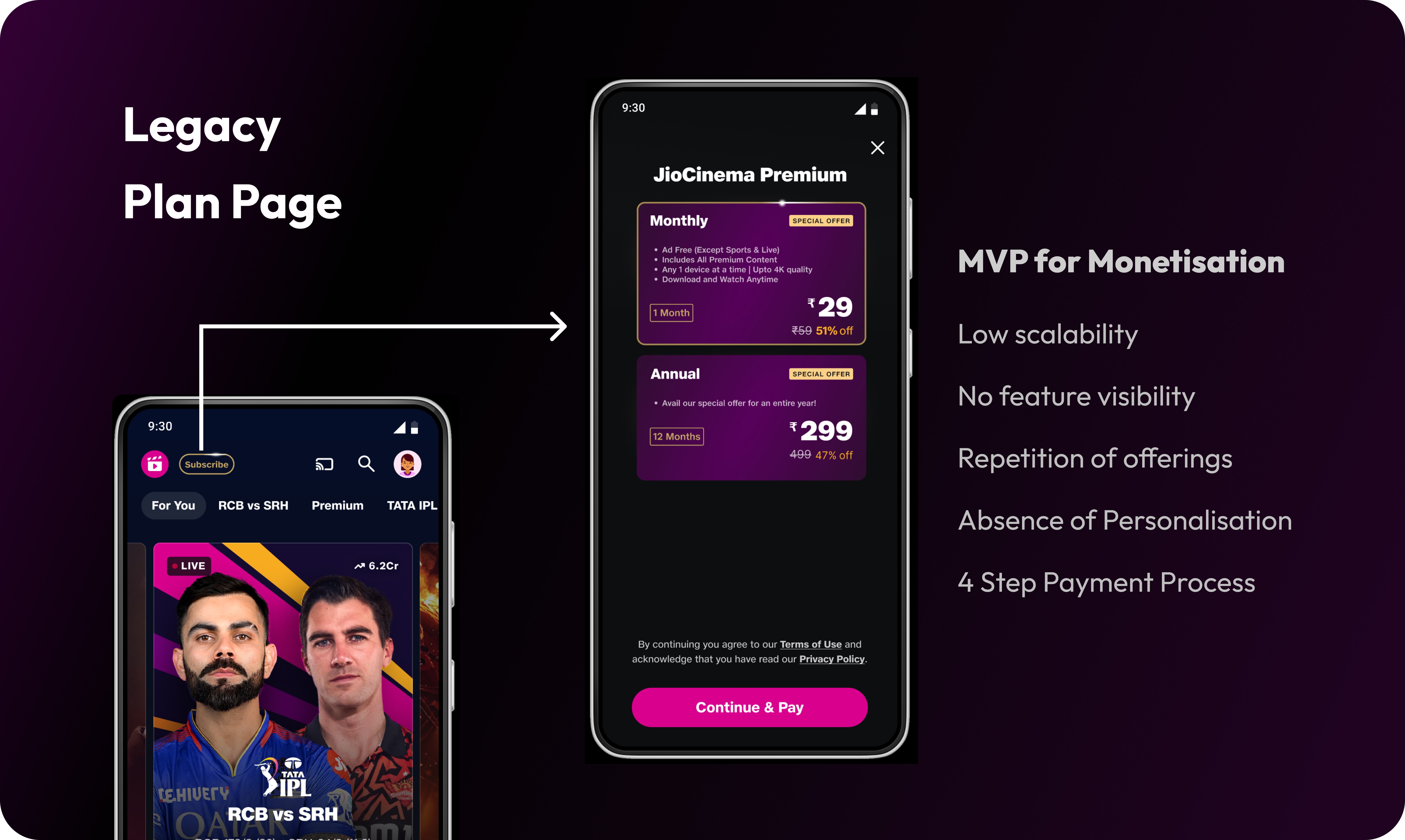
  • Only two generic plans for everyone, no personalisation or relevance.

  • Crowded, hard-to-compare plan cards causing cognitive overload

  • Premium value poorly communicated — users didn’t know what they were missing

  • Monetisation patterns inconsistent across entry points

  • System was rigid — every new plan required manual redesign and engineering effort

The more I investigated, the clearer it became:
this wasn’t a plan-page problem — it was a system problem.

While working on personalisation initiatives, I noticed a pattern:

Users were dropping off during conversion, not because of price but because the system itself was rigid and confusing.

Key issues:

  • Only two generic plans for everyone, no personalisation or relevance.

  • Crowded, hard-to-compare plan cards causing cognitive overload

  • Premium value poorly communicated — users didn’t know what they were missing

  • Monetisation patterns inconsistent across entry points

  • System was rigid — every new plan required manual redesign and engineering effort

The more I investigated, the clearer it became:
this wasn’t a plan-page problem — it was a system problem.

🔎 Plan of action

Revamp the "Premium positioning" with new branding, Ui revamp, strategic exclusive personalised plans build to promote customer retention and loyalty along with a modular internal Ui structure which can give flexibility to the business team to test and experiment with different plans. Basically creating a new subscription ecosystem that could scale across content types, pricing models and devices.

Revamp the "Premium positioning" with new branding, Ui revamp, strategic exclusive personalised plans build to promote customer retention and loyalty along with a modular internal Ui structure which can give flexibility to the business team to test and experiment with different plans. Basically creating a new subscription ecosystem that could scale across content types, pricing models and devices.

Timeline

2023 - 2024
7 months


4 months

2024

User Base

150 Million+

Users

Domain

OTT, Entertainment


Company

Viacom 18 Digital

Media

Timeline

2023 - 2024
7 months


User Base

150 Million+

Users

Domain

OTT, Entertainment


Company

Viacom 18 Digital

Media

👥 The Team

👥 The Team

👥 The Team

This was a big design-led initiative across:

  • Design team- Head of Design, 2 Designers and a Design Manager

  • Product team- VP of Product, Director, 2 PMs

  • Business team- SVP & VP business & acquisition

  • Engineering team- Senior stakeholders and 16 people across devices, QA & backend.

This was a big design-led initiative across:

  • Design team- Head of Design, 2 Designers and a Design Manager

  • Product team- VP of Product, Director, 2 PMs

  • Business team- SVP & VP business & acquisition

  • Engineering team- Senior stakeholders and 16 people across devices, QA & backend.

My Contribution

co-owned the end-to-end monetisation revamp, from opportunity discovery to system design and validation. This included:

  • Reframing the problem from “redesign the plan page” to “design a scalable monetisation system”

  • Aligning design, product, business, and engineering on a phased roadmap

  • Designing a modular subscription architecture that could scale across platforms and content types

co-owned the end-to-end monetisation revamp, from opportunity discovery to system design and validation. This included:

  • Reframing the problem from “redesign the plan page” to “design a scalable monetisation system”

  • Aligning design, product, business, and engineering on a phased roadmap

  • Designing a modular subscription architecture that could scale across platforms and content types

co-owned the end-to-end monetisation revamp, from opportunity discovery to system design and validation. This included:

  • Reframing the problem from “redesign the plan page” to “design a scalable monetisation system”

  • Aligning design, product, business, and engineering on a phased roadmap

  • Designing a modular subscription architecture that could scale across platforms and content types

Validating the problem

Validating the problem

Validating the problem

While interviewing users, I found out:

  • There are too many steps during payment = frustration + drop-offs.

  • Plan comparison felt confusing, making it hard to choose. It was wordy and no comparison with limited options.

  • Premium content wasn’t clearly highlighted, so many didn’t even know what they were missing out on.

  • Advertisements in the paid service compromised the overall experience and irritated the users. It was because plans were structured only to monetise content.

For the business, the pain was structural:

  • JioCinema started off as a freemium service. With sports and international content (HBO, Warner Bros & Peacock) coming in, 2 new content specific plans were introduced.

  • Only two rigid plans → no room to experiment. Launching a new one meant manual design and engineering effort each time and the system wasn’t built to support variation. It was structural inflexibility. The existing system prevented rapid experimentation, slowing down revenue innovation in a highly competitive OTT market.

  • The UI didn’t reflect the premium positioning and branding.

In short:
The product wasn’t scaling with user expectations and the business couldn’t evolve monetisation fast enough in a highly competitive OTT market.

While interviewing users, I found out:

  • There are too many steps during payment = frustration + drop-offs.

  • Plan comparison felt confusing, making it hard to choose. It was wordy and no comparison with limited options.

  • Premium content wasn’t clearly highlighted, so many didn’t even know what they were missing out on.

  • Advertisements in the paid service compromised the overall experience and irritated the users. It was because plans were structured only to monetise content.

For the business, the pain was structural:

  • JioCinema started off as a freemium service. With sports and international content (HBO, Warner Bros & Peacock) coming in, 2 new content specific plans were introduced.

  • Only two rigid plans → no room to experiment. Launching a new one meant manual design and engineering effort each time and the system wasn’t built to support variation. It was structural inflexibility. The existing system prevented rapid experimentation, slowing down revenue innovation in a highly competitive OTT market.

  • The UI didn’t reflect the premium positioning and branding.

In short:
The product wasn’t scaling with user expectations and the business couldn’t evolve monetisation fast enough in a highly competitive OTT market.

✨ Strategy Shift: From Screens to Systems

✨ Strategy Shift: From Screens to Systems

✨ Strategy Shift: From Screens to Systems

Initially, the brief was a plan page redesign. Through competitor analysis, user interviews and internal audits,
I noticed patterns JioCinema was missing: rentals, flexible plan structures, hybrid models. Voicing the findings, pitch reframed the initiative from “improving plan visuals” to introducing new revenue mechanics, which expanded the project scope and roadmap ownership.

This shifted the project from a visual refresh to a structural revamp. We wanted to build personalised subscriptions. The result: the introduction of TVOD (Transactional Video on Demand): a design-led business model extension.

Initially, the brief was a plan page redesign. Through competitor analysis, user interviews and internal audits,
I noticed patterns JioCinema was missing: rentals, flexible plan structures, hybrid models. Voicing the findings, pitch reframed the initiative from “improving plan visuals” to introducing new revenue mechanics, which expanded the project scope and roadmap ownership.

This shifted the project from a visual refresh to a structural revamp. We wanted to build personalised subscriptions. The result: the introduction of TVOD (Transactional Video on Demand): a design-led business model extension.

Initially, the brief was a plan page redesign. Through competitor analysis, user interviews and internal audits,
I noticed patterns JioCinema was missing: rentals, flexible plan structures, hybrid models. Voicing the findings, pitch reframed the initiative from “improving plan visuals” to introducing new revenue mechanics, which expanded the project scope and roadmap ownership.

This shifted the project from a visual refresh to a structural revamp. We wanted to build personalised subscriptions. The result: the introduction of TVOD (Transactional Video on Demand): a design-led business model extension.

Requirement

Scalable Ui revamp for introducing multiple plans across Mobile, TV, Web and Tablet

Scaled System

  • Instead of a plan page, delivering a monetisation model.

  • Strategically breaking it into phases to align with new plan releases and engineering bandwidth.

Re-defining Scope

  • Aligning Stakeholders and
    re-defining requirements.

  • Understanding Engineering limitations.

  • Managing Trade-offs.

Research

Problem Analysis

Digging deep to find 5Ws for the requirement.

Opportunity Discovery

Brainstorming to Identify new monetisation models.

⚠️ What is TVOD (and why it mattered)??

TVOD stands for Transactional Video on Demand.

It allowed users to:

  • Rent premium content without committing to a full subscription.

  • Access high-value content contextually.
For the business:

  • Opened a new monetisation stream.

  • Allowed flexible pricing for different audience segments.

  • Reduced friction for high-intent, low-commitment users.

This wasn’t a UI tweak, it was design shaping business strategy.

TVOD stands for Transactional Video on Demand.

It allowed users to:

  • Rent premium content without committing to a full subscription.

  • Access high-value content contextually.
For the business:

  • Opened a new monetisation stream.

  • Allowed flexible pricing for different audience segments.

  • Reduced friction for high-intent, low-commitment users.

This wasn’t a UI tweak, it was design shaping business strategy.

TVOD stands for Transactional Video on Demand.

It allowed users to:

  • Rent premium content without committing to a full subscription.

  • Access high-value content contextually.

For the business:

  • Opened a new monetisation stream.

  • Allowed flexible pricing for different audience segments.

  • Reduced friction for high-intent, low-commitment users.

This wasn’t a UI tweak, it was design shaping business strategy.

✨ Phased Execution Plan

✨ Phased Execution Plan

✨ Phased Execution Plan

Due to tight timelines and engineering bandwidth constraints, the product team deliberately broke delivery into phased releases. Design team owned the end-state system, while partnering with PMs to ship incrementally without creating redesign debt.

Phase 1 — Laying the Foundation (Shipped)

The first priority was simple but critical: fix the foundations before adding complexity.
At the time, the plan page was rigid, hard to evolve, and expensive to maintain. If we wanted personalisation or new monetisation models later, the system itself had to change.

The goal

Create a scalable subscription foundation that could support future personalisation and monetisation, while also improving conversion in the short term.

What was shipped

In Phase 1, I redesigned the plan experience as a system, not just a screen:

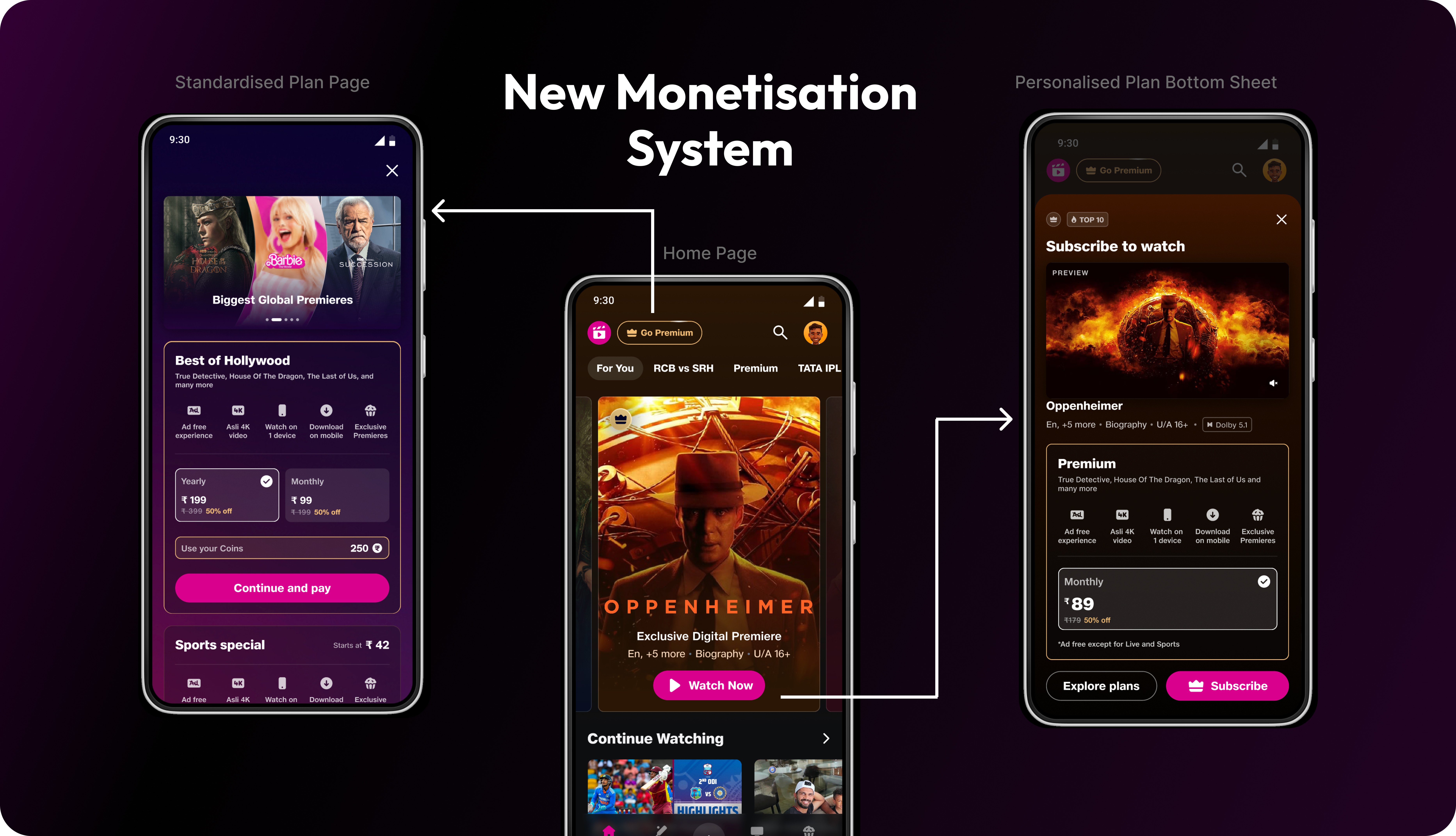
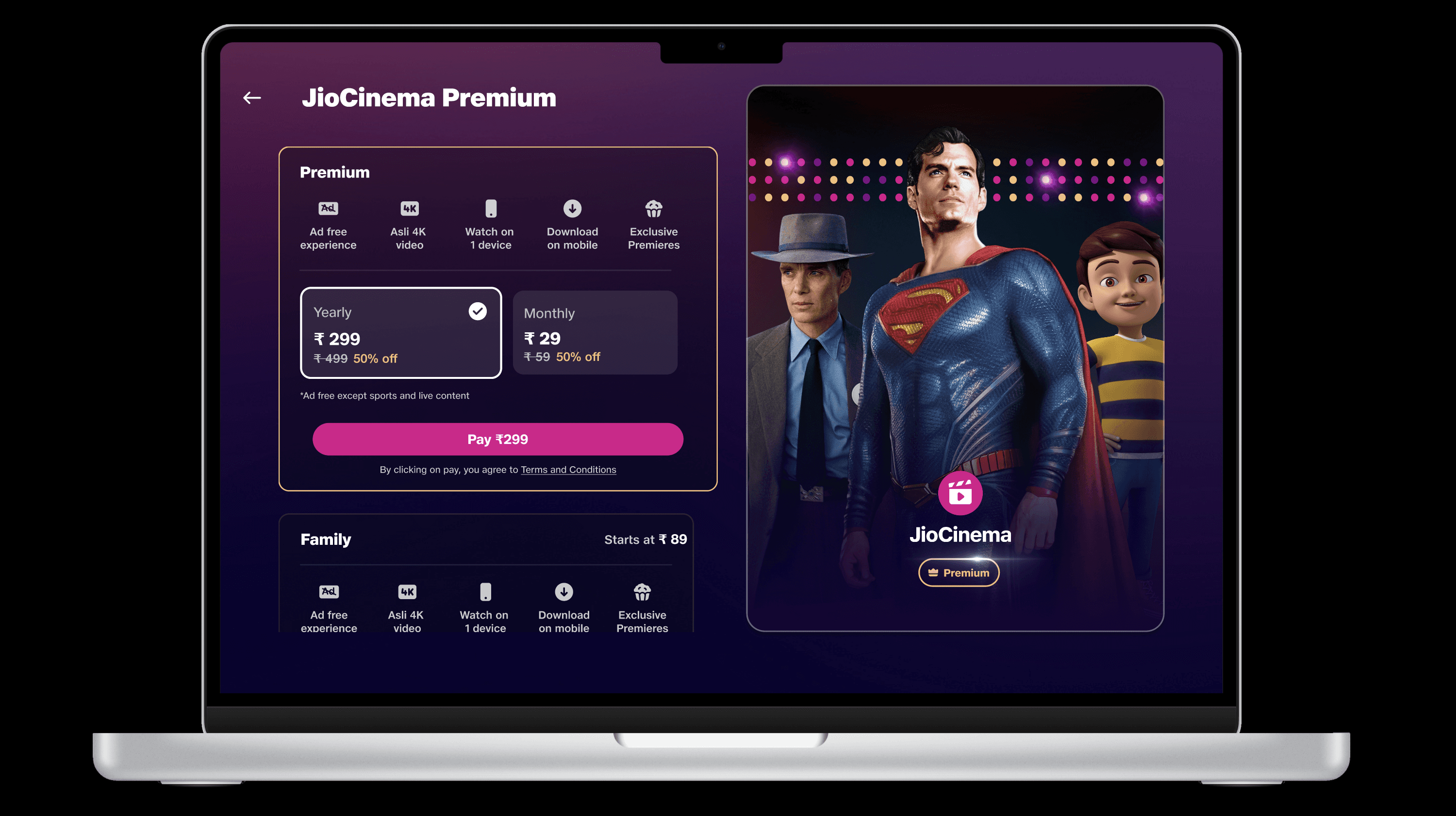
  • scalable plan page structure, with templated cards, flexible durations, and feature toggles.

  • simplified payment flow across Mobile, TV, Tablet, and Desktop to reduce drop-offs.

  • Clear upgrade journeys for existing subscribers.

  • Cross-platform parity, so monetisation logic stayed consistent regardless of device.

Due to tight timelines and engineering bandwidth constraints, the product team deliberately broke delivery into phased releases. Design team owned the end-state system, while partnering with PMs to ship incrementally without creating redesign debt.

Phase 1 — Laying the Foundation (Shipped)

The first priority was simple but critical: fix the foundations before adding complexity.
At the time, the plan page was rigid, hard to evolve, and expensive to maintain. If we wanted personalisation or new monetisation models later, the system itself had to change.

The goal

Create a scalable subscription foundation that could support future personalisation and monetisation, while also improving conversion in the short term.

What was shipped

In Phase 1, I redesigned the plan experience as a system, not just a screen:

  • scalable plan page structure, with templated cards, flexible durations, and feature toggles.

  • simplified payment flow across Mobile, TV, Tablet, and Desktop to reduce drop-offs.

  • Clear upgrade journeys for existing subscribers.

  • Cross-platform parity, so monetisation logic stayed consistent regardless of device.

Due to tight timelines and engineering bandwidth constraints, the product team deliberately broke delivery into phased releases. Design team owned the end-state system, while partnering with PMs to ship incrementally without creating redesign debt.

Phase 1 — Laying the Foundation (Shipped)

The first priority was simple but critical: fix the foundations before adding complexity.
At the time, the plan page was rigid, hard to evolve, and expensive to maintain. If we wanted personalisation or new monetisation models later, the system itself had to change.

The goal

Create a scalable subscription foundation that could support future personalisation and monetisation, while also improving conversion in the short term.

What was shipped

In Phase 1, I redesigned the plan experience as a system, not just a screen:

  • scalable plan page structure, with templated cards, flexible durations, and feature toggles.

  • simplified payment flow across Mobile, TV, Tablet, and Desktop to reduce drop-offs.

  • Clear upgrade journeys for existing subscribers.

  • Cross-platform parity, so monetisation logic stayed consistent regardless of device.

Key Design Decisions (Phase 1)

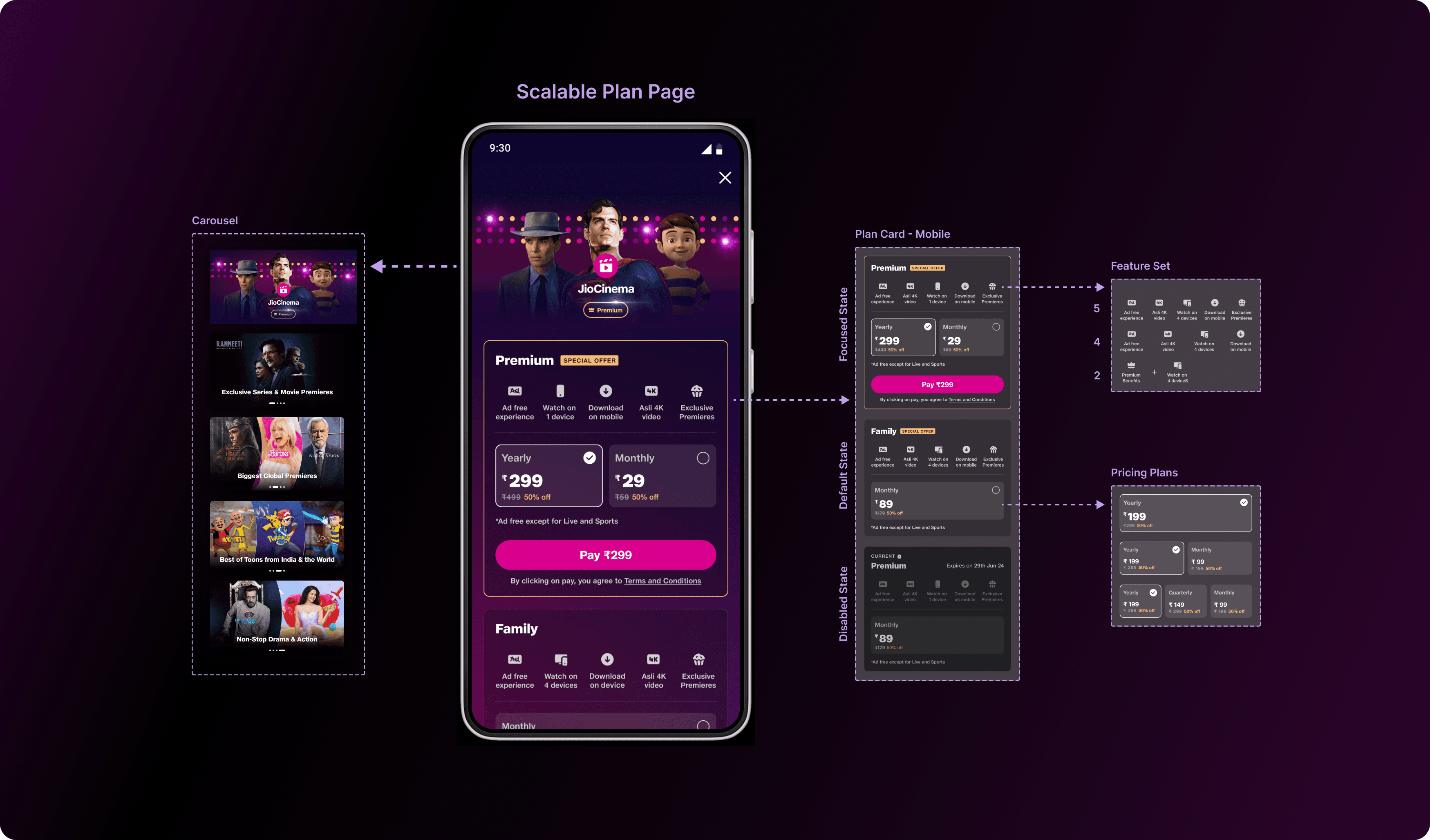
1. Templatised plan cards

  • The earlier plan cards were wordy and hard to compare. I redesigned them with a clear information hierarchy so key differences were immediately scannable.

  • To account for India’s linguistic diversity, the reliance on copy was reduced by introducing visual cues and iconography to differentiate content buckets, enabling quicker understanding even with limited reading.

The structural win: new plans could be introduced without redesign across mobile, tablet, desktop & TV.
Each card followed a consistent template, allowing pricing, features, and durations to be swapped or extended without breaking the experience.
📊 Impact

  • To meet tight timelines, the redesigned generic plan page was released to 100% of users, timed ahead of high-traffic reality show launches.

  • Within the first two weeks, we saw a 32% increase in plan adoption, validating that improved structure, clarity and systemisation alone, even without personalisation it significantly improved conversion.

Phase 2 — Personalisation & Contextual Upsell (Shipped)

After shipping the core plan system, I looked across the product to identify natural, high-intent upsell and upgrade moments. This surfaced 8 opportunities within mid-journey flows like content discovery and playback entry points.

A key decision in Phase 2 was to introduce monetisation without interrupting viewing. Instead of hard paywalls, upsells were designed as contextual nudges, shown only when directly relevant to what the user was doing.

What shipped:

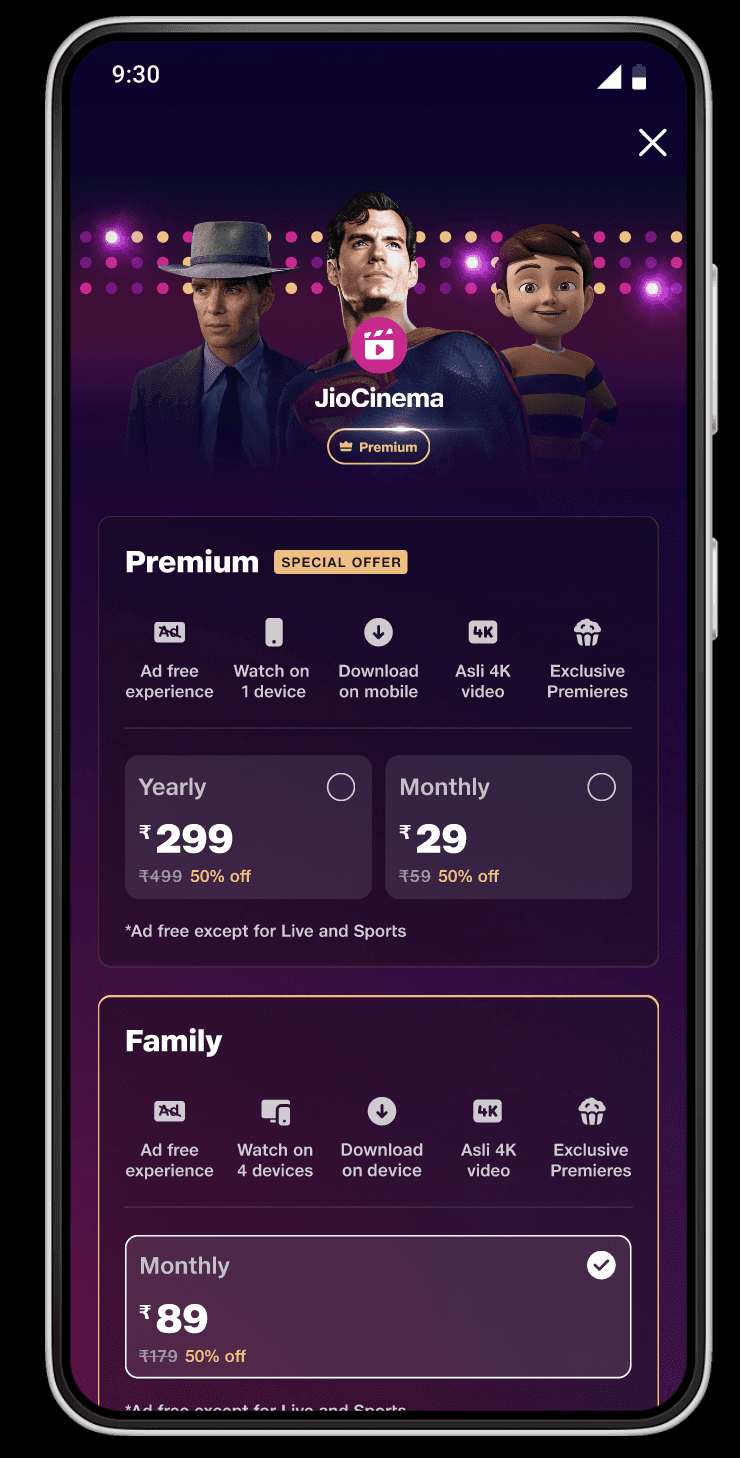
  • Content-aware plan recommendations (e.g. Hollywood plan surfaced while viewing Hollywood content).

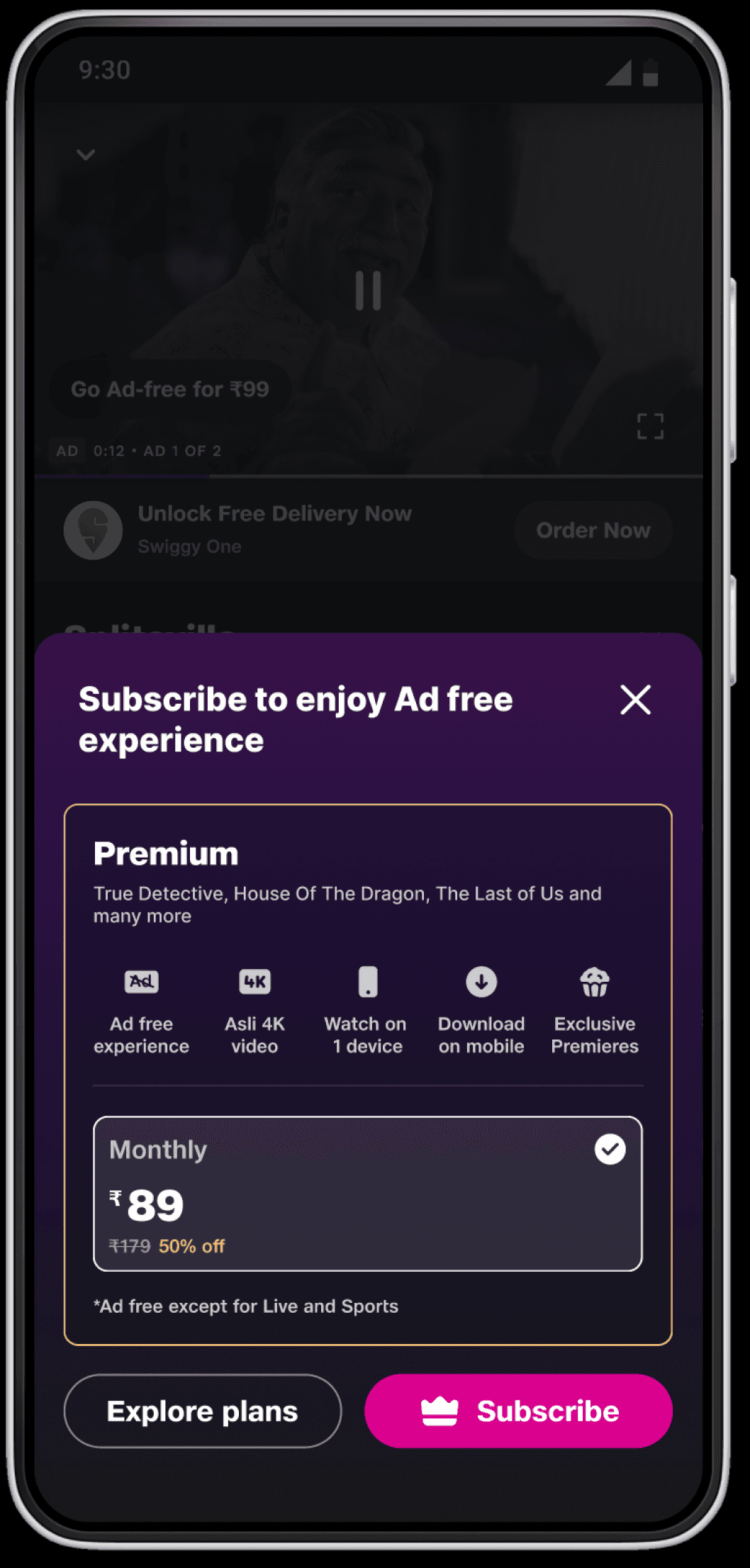
  • Ads-free upgrades for existing subscribers.

  • Contextual upsell via bottom sheets (mobile & tablet).

Phase 2 — Personalisation & Contextual Upsell (Shipped)

After shipping the core plan system, I looked across the product to identify natural, high-intent upsell and upgrade moments. This surfaced 8 opportunities within mid-journey flows like content discovery and playback entry points.

A key decision in Phase 2 was to introduce monetisation without interrupting viewing. Instead of hard paywalls, upsells were designed as contextual nudges, shown only when directly relevant to what the user was doing.

What shipped:

  • Content-aware plan recommendations (e.g. Hollywood plan surfaced while viewing Hollywood content).

  • Ads-free upgrades for existing subscribers.

  • Contextual upsell via bottom sheets (mobile & tablet).

Phase 2 — Personalisation & Contextual Upsell (Shipped)

After shipping the core plan system, I looked across the product to identify natural, high-intent upsell and upgrade moments. This surfaced 8 opportunities within mid-journey flows like content discovery and playback entry points.

A key decision in Phase 2 was to introduce monetisation without interrupting viewing. Instead of hard paywalls, upsells were designed as contextual nudges, shown only when directly relevant to what the user was doing.

What shipped:

  • Content-aware plan recommendations (e.g. Hollywood plan surfaced while viewing Hollywood content).

  • Ads-free upgrades for existing subscribers.

  • Contextual upsell via bottom sheets (mobile & tablet).

Key Design Decisions (Phase 2)

1. Bottom sheets as the primary pattern (Mobile & Tablet)
Upsells were delivered via bottom sheets to keep users in flow without breaking context. This required close collaboration with other designers to align with existing interaction patterns and avoid disruption. This approach:

  • Enabled progressive disclosure of value

  • Scaled consistently across platforms

  • Reduced friction compared to full-screen redirects

2. Why device specific personalisation?
It was intentionally limited to mobile and tablet, as desktop and TV are largely shared devices in the Indian cohort. Restricting personalised upsells to personal devices helped avoid relevance mismatches and preserved trust in shared-screen contexts. For other platforms, the touch-point would lead to the new plan page.

1. Bottom sheets as the primary pattern (Mobile & Tablet)
Upsells were delivered via bottom sheets to keep users in flow without breaking context. This required close collaboration with other designers to align with existing interaction patterns and avoid disruption. This approach:

  • Enabled progressive disclosure of value

  • Scaled consistently across platforms

  • Reduced friction compared to full-screen redirects

2. Why device specific personalisation?
It was intentionally limited to mobile and tablet, as desktop and TV are largely shared devices in the Indian cohort. Restricting personalised upsells to personal devices helped avoid relevance mismatches and preserved trust in shared-screen contexts. For other platforms, the touch-point would lead to the new plan page.

1. Bottom sheets as the primary pattern (Mobile & Tablet)
Upsells were delivered via bottom sheets to keep users in flow without breaking context. This required close collaboration with other designers to align with existing interaction patterns and avoid disruption. This approach:

  • Enabled progressive disclosure of value

  • Scaled consistently across platforms

  • Reduced friction compared to full-screen redirects

2. Why device specific personalisation?
It was intentionally limited to mobile and tablet, as desktop and TV are largely shared devices in the Indian cohort. Restricting personalised upsells to personal devices helped avoid relevance mismatches and preserved trust in shared-screen contexts. For other platforms, the touch-point would lead to the new plan page.

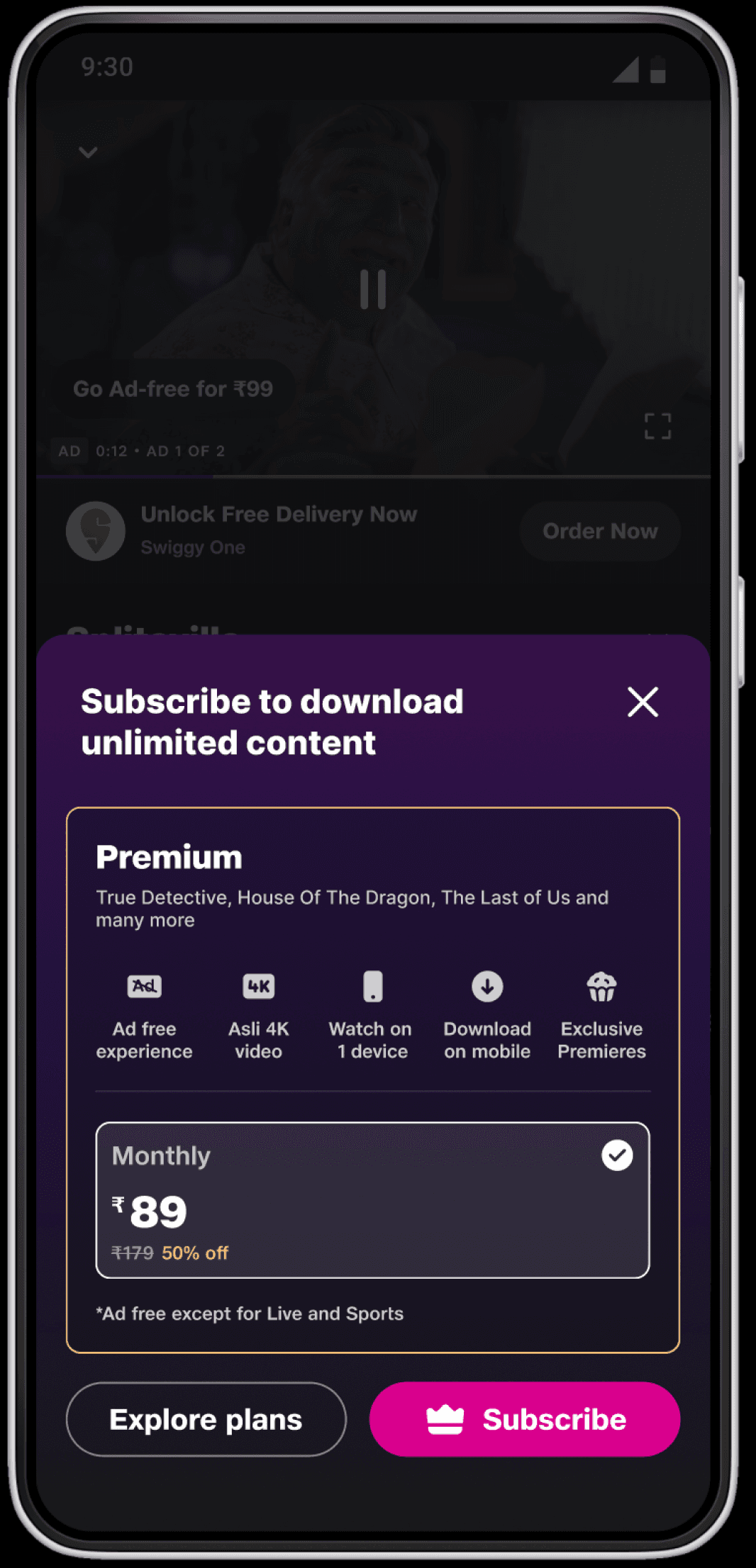
Content Player

During Advertisement

Downloading content

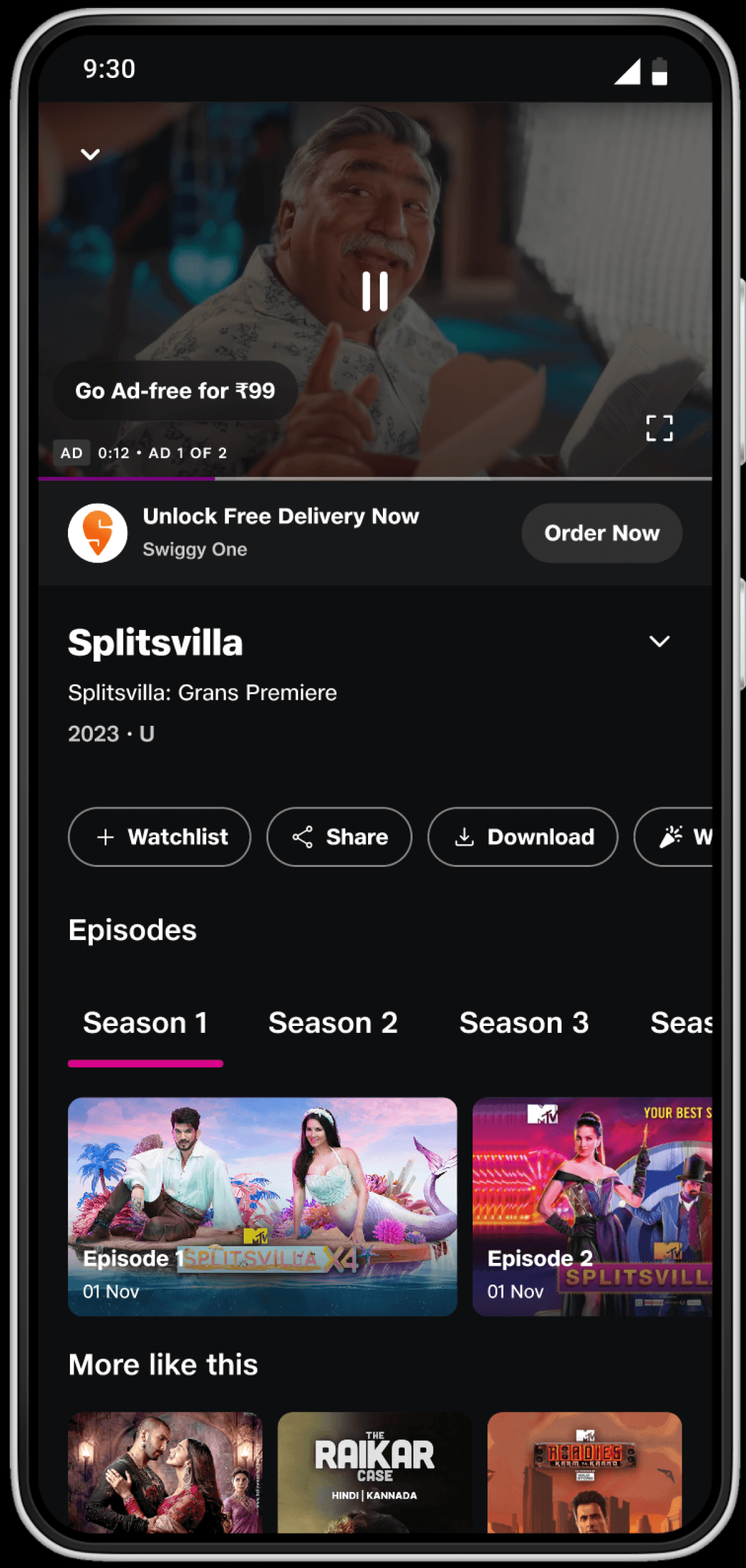
User sees a ‘Go Ad Free’ button as soon as the Ad begins to play.

User attempts to ‘Download’
content.

📊 Impact

  • Upsells were shown only at high-intent moments, making plan discovery more relevant.

  • 73% adoption of the Sports-only plan in a 1% mobile cohort before IPL, validated demand for content-specific plans.

  • Established a scalable upsell pattern later used across JioCinema.
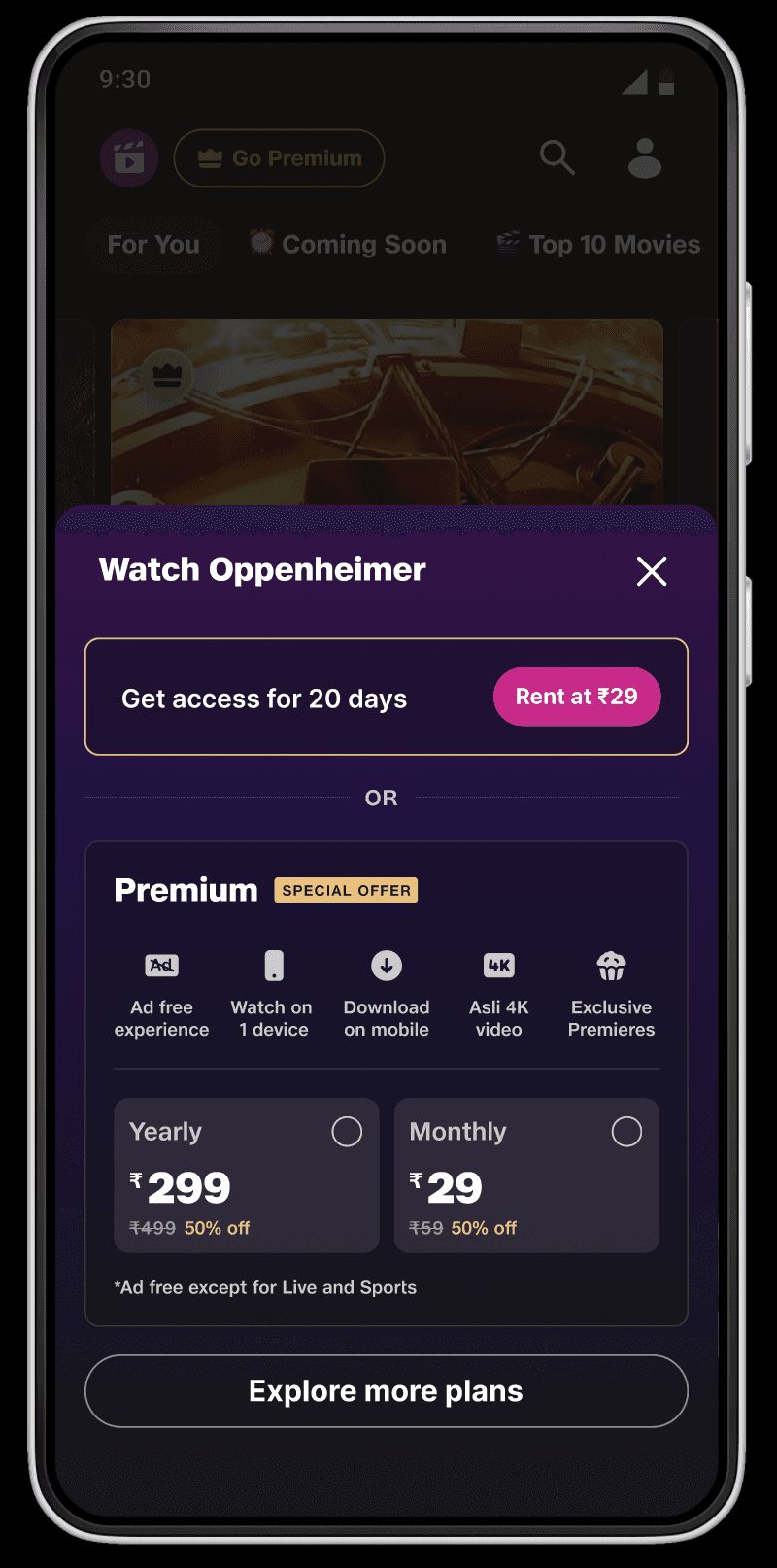
Phase 3 — TVOD Enablement (Planned)

The final phase focused on extending the subscription system to support Transactional Video on Demand (TVOD) — allowing users to rent premium content without committing to a full plan.

TVOD was designed to plug into the existing plan architecture, reusing the same components, payment logic, and entitlement rules. This ensured rental flows could be introduced without reworking the core experience.

What was designed

  • Rental flows for premium content.

  • Pricing and entitlement logic aligned with the plan system.

The system was TVOD-ready, enabling rollout through configuration rather than redesign when business priorities aligned.

Phase 3 — TVOD Enablement (Planned)

The final phase focused on extending the subscription system to support Transactional Video on Demand (TVOD) — allowing users to rent premium content without committing to a full plan.

TVOD was designed to plug into the existing plan architecture, reusing the same components, payment logic, and entitlement rules. This ensured rental flows could be introduced without reworking the core experience.

What was designed

  • Rental flows for premium content.

  • Pricing and entitlement logic aligned with the plan system.

The system was TVOD-ready, enabling rollout through configuration rather than redesign when business priorities aligned.

Phase 3 — TVOD Enablement (Planned)

The final phase focused on extending the subscription system to support Transactional Video on Demand (TVOD) — allowing users to rent premium content without committing to a full plan.

TVOD was designed to plug into the existing plan architecture, reusing the same components, payment logic, and entitlement rules. This ensured rental flows could be introduced without reworking the core experience.

What was designed

  • Rental flows for premium content.

  • Pricing and entitlement logic aligned with the plan system.

The system was TVOD-ready, enabling rollout through configuration rather than redesign when business priorities aligned.

⚠️ Impact & Outcomes

  • 39% increase in plan adoption within two weeks of Phase 1 rollout, validating the impact of clearer structure and systemisation under peak traffic.

  • 73% adoption of the Sports-only plan within a 1% mobile cohort, timed ahead of IPL.

  • Improved discoverability and uptake of premium and ads-free plans through contextual upsell.

  • Enabled faster go-to-market for new plans via configuration rather than redesign.

  • Reduced ongoing design and engineering effort for monetisation launches.

(Exact conversion, ARPU, and revenue figures are under NDA.)


⚠️ What I’d Do Differently

  • Run earlier dedicated usability testing for TV remote-based flows.

  • Invest in deeper longitudinal analysis on retention and repeat rentals once TVOD launched.

  • Explore pricing psychology and bundling experiments once the system matured.